SUD dependency relations
Structure of dependency relations
In SUD, each dependency relation is made of up to three parts:
- a required main relation
- an optional subrelation (prefixed by
:) - an optional deep_feature (prefixed by
@)
Some examples of the four possible cases:
- Only main relation: cc
- with a subrelation only: comp:obj
- with a deep feature only: subj@expl
- with both: comp:aux@tense
about mSUD
In mSUD, there is a fourth part called
typeand prefixed by/
SUD specific main relations
In SUD there are three specific (i.e. not used in UD) main relation:
subj,
comp and
mod.
The schema below shows these relations and their standard extensions (possible combination of subrelations and deep features.
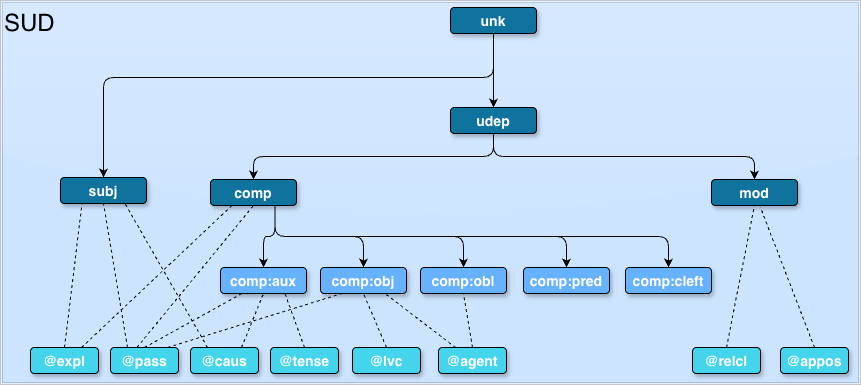
The schema also introduce two underspecified relation specificaly used in SUD:
udepwith stands for a relation which is either acompor amod. It is typically used for noun complements for which distinction is not done in most of the cases. See for example in SUD_French-GSD.unkwith stands for a relation which is unkonwn: no specific dependency could be identified. It is mainly used in annotation of idioms.
Other common relations and extensions
Here is a list of commonly used main relations in SUD, with their common extensions.
cccompoundconjconj:apposconj:coordconj:dictoconj:reform
detdiscoursedislocateddislocated:moddislocated:objdislocated:obldislocated:subjdislocated:unk
flatflat@foreignflat@name
goeswithorphanparataxisparataxis:insertparataxis:parenth
punctrepairrootvocative
Note
In treebanks converted from UD to SUD, other deep extensions may appear. See examples in English treebanks:
@desc,@npmod,@poss,@tmodand@unmarkedare used to keep track of UD subrelations.